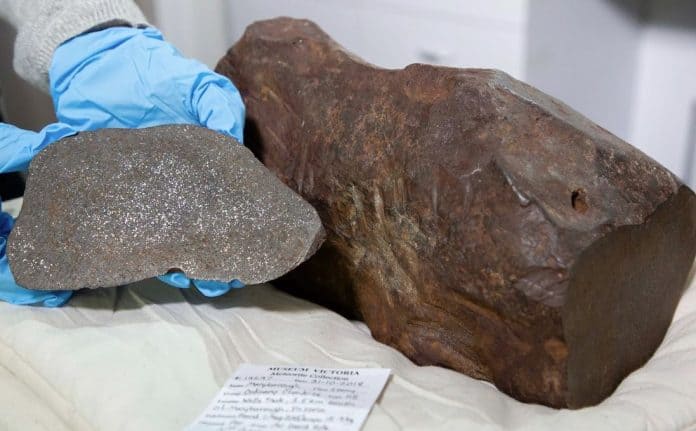
A heavy stone found by a gold prospector, which managed to withstand acid, drills, and even blows from a sledgehammer, has been confirmed as a rare meteorite that formed during the earliest days of the solar system.
In May 2015, David Hold was using his metal detector in Maryborough Regional Park near Melbourne when he spotted a reddish 17-kilogram rock wedged in an ironbark tree about two kilometres from the town of Maryborough.
Over the next several years, he tried to break it open with a variety of tools, including a drill, an angle grinder, and a rock saw, but he never managed to crack it.
He even tried soaking it in acid and striking it with a sledgehammer, but the rock refused to break.
In 2018, still hoping to understand what he had found, he brought the specimen to Museums Victoria in Melbourne.
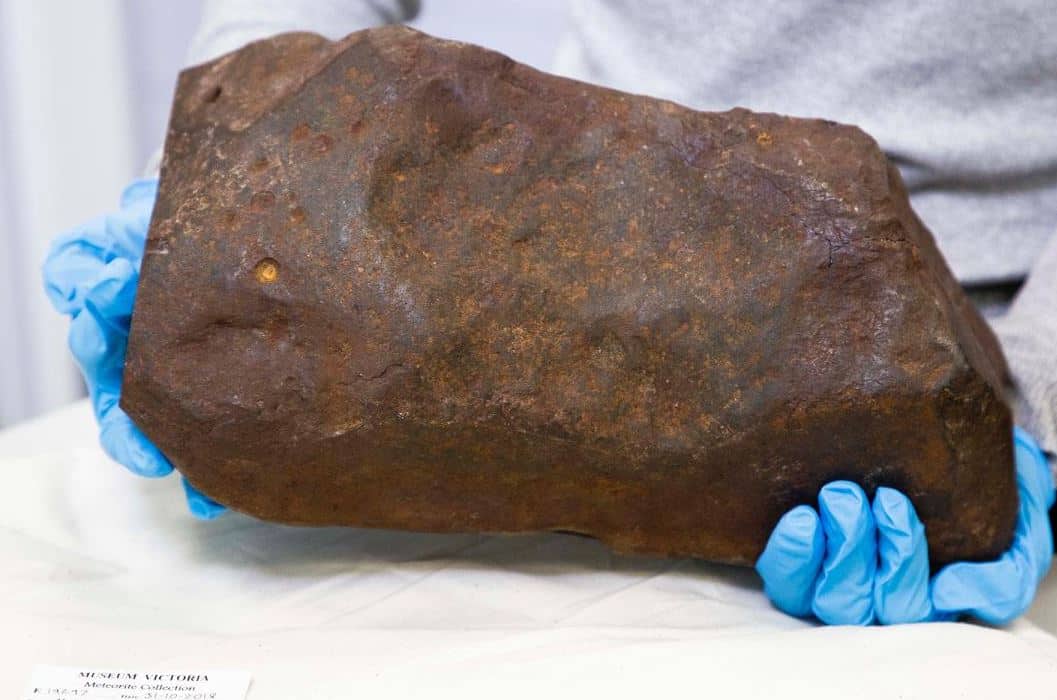
The object measured roughly 38.5 centimetres in length, 14.5 centimetres in width, and 14.5 centimetres in height, and weighed about 37.5 pounds, or 17 kilograms.
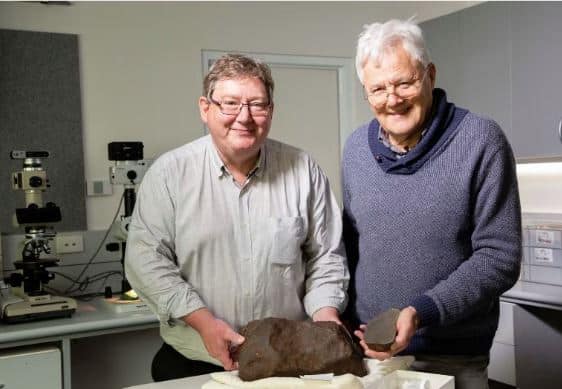
Dermot Henry, the museum’s Head of Sciences, and Bill Birch, an emeritus curator in geosciences, took a closer look at it.
Henry noted that the stone had a “dimpled, sculpted appearance.” He explained that this texture forms when the outside of a meteorite melts as it passes through Earth’s atmosphere.
He also said he has examined many rocks brought in by people who believed they had found meteorites, and that in his 37 years at the museum, during which he has assessed thousands of specimens, this is only the second genuine meteorite he has ever identified.
Birch pointed out that an ordinary Earth rock of this size would never be so heavy.
Examining the Specimen
Researchers cut off a thin section of the specimen using a diamond saw to figure out what it was made of.
A microprobe analysis later revealed that it is an H5 ordinary chondrite. The “H” label indicates that it contains a high amount of iron, and the “5” refers to the fact that it experienced significant heating on its parent asteroid while still keeping much of its original texture.
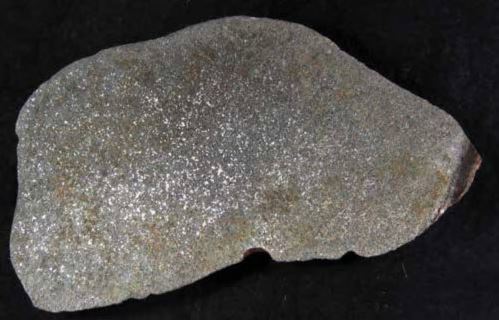
The meteorite is made up of tiny, crystallised metal-rich spheres known as chondrules, each up to about one millimetre in size.
These small droplets formed when dust clouds in the young solar system were rapidly heated around 4.6 billion years ago.
Experts think this particular meteorite came from the asteroid belt located between Mars and Jupiter.
Unlike many meteorites that show signs of violent collisions, this one does not contain high-pressure features, which suggests it avoided major impacts before reaching Earth.
Radiocarbon testing shows it has been on the planet for somewhere between 100 and 1,000 years; it also displays early signs of weathering, which matches what would be expected if it had been lying in a forested area for a long period.
While scientists were unable to pinpoint when it landed, historical reports note several meteor sightings in the region from 1889 to 1951.