
Health officials are watching a new COVID-19 variant spreading across the U.S., and experts say it could get past some of the protection current vaccines offer.
The strain, called BA 3.2, has shown up in nasal swabs from four travelers returning to the U.S., along with samples from five patients across five different states, though those states haven’t been identified.

BA 3.2 was first identified in South Africa in 2024, then appeared in the U.S. in June 2025 in a traveler arriving from the Netherlands.
By September 2025, cases linked to the variant started rising, and it has since been reported in 23 countries worldwide.
Researchers note that its evolution follows a pattern similar to the BA 3.8.6 variant from 2024, which eventually evolved into JN.1, the dominant strain that year.
That said, scientists emphasize that BA 3.2 is genetically different from the JN.1-related variants that have been spreading throughout the U.S. since early 2024.
The spread of the new variant could warrant an update to the current vaccines, which only target the JN.1 subvariants.

BA.3.2 has around 70 to 75 percent changes in its spike protein, which is the part that helps the virus get into human cells; because of that, it may be better at getting around the immune system.
Up to now, cases tied to the variant have been identified in a long list of states, including Connecticut, Florida, California, Idaho, New Hampshire, Hawaii, Maryland, Maine, Illinois, Missouri, Massachusetts, Nevada, New Jersey, New York, Rhode Island, Pennsylvania, Texas, South Carolina, Virginia, Vermont, Utah, Ohio, Louisiana, Michigan, and Wyoming.
That said, it’s still unclear what kind of impact this variant will have.
Data from a CDC tracker shows BA.3.2 isn’t currently a dominant strain in the U.S.
The variant has been spotted in hospitalized patients between December and January.
Those cases included two older adults with pre-existing health issues, along with a young child who was treated without being admitted.
Experts say respiratory illnesses like RSV and the flu have actually been spreading more than COVID during this winter’s seasonal surge.
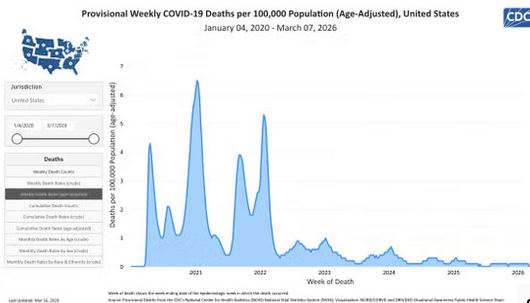
They also expect another possible uptick in cases over the summer, a pattern that’s been showing up in the years since the beginning of the pandemic.
The good news is that COVID-related deaths have gone down since 2025. Positive COVID tests and emergency room visits have also decreased.
However, many people are still dying from the virus, according to CDC data.